
Water Quality Reports
OUR MOST ESSENTIAL RESOURCE
Where Your Water Comes From
Greater Cincinnati Water Works (GCWW) supplies water from two sources: the Ohio River and the Great Miami Buried Valley Aquifer (GMBVA). Surface water from the Ohio River is treated at the Richard Miller Treatment Plant (RMTP). This plant, located on the east side of Hamilton County, supplies about 88% of drinking water to GCWW’s customers. The Charles M. Bolton Treatment Plant (CMBP) treats groundwater from 13 wells in the GMBVA. It is located in southern Butler County and supplies about 12% of the drinking water to GCWW customers.
Service Area Map
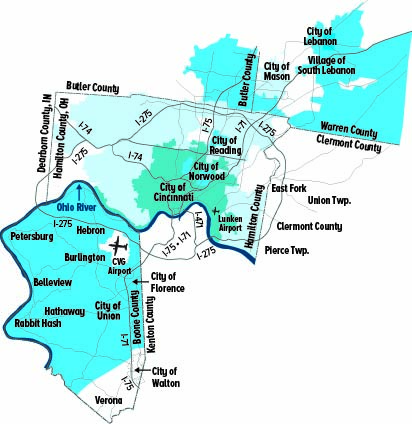 Click to enlarge
GCWW supplies about 45 billion gallons of water each year through more than 3,100 miles of water mains to 243,000 residential and commercial accounts, representing at least 1.1 million customers. The GCWW service area includes the entire City of Cincinnati, most of Hamilton County, and parts of Butler and Warren Counties in Ohio, and Boone County in Kentucky.
Only Your Tap Water Delivers These Protective Benefits
Protection of Public Health and Welfare
A safe water supply is critical to protecting public health. In the United States, water utilities monitor for more than 100 contaminants and must meet close to 90 regulations for water supply and quality. The same system of water mains, pumps, and storage tanks transports water to home faucets and fire hydrants. GCWW also takes great care to protect your water supply from chemical spills into the Ohio River that could contaminate it. GCWW can shut down river intake pumping, utilize stored and supplementary water until the spill passes, and use advanced treatment systems to remove contaminants.
Sources of Your Drinking Water
The sources of drinking water - both tap and bottled - include rivers, lakes, streams, ponds, reservoirs, springs, and wells. As water travels over the surface of the land or through the ground, it dissolves naturally-occurring minerals (in some cases radioactive material) and can pick up substances resulting from the presence of animals or from human activity. As with all surface waters, the Ohio Environmental Protection Agency (EPA) has classified the Ohio River as highly susceptible to potential contamination. The Ohio EPA has also classified our portion of the GMBVA as highly susceptible to contamination due to a lack of an overlying protective clay layer, the presence of low levels of nitrate in the groundwater, and the presence of nearby potential contaminant sources. The Ohio EPA provided the most recent assessments in 2009, and GCWW updated the Source Water Protection Plan for the Richard Miller Treatment Plant, which includes updated assessment material, in December 2025.
Contaminants that may be present in source water include:
> Microbial contaminants, such as viruses and bacteria, which may come from sewage treatment plants, septic systems, agricultural livestock operations, and wildlife;
> Inorganic contaminants, such as salts and metals, which can be naturally-occurring or result from urban stormwater runoff, industrial or domestic wastewater discharges, oil and gas production, mining, or farming;
> Pesticides and herbicides, which may come from a variety of sources such as agriculture, urban stormwater runoff, and residential uses;
> Organic chemical contaminants, including synthetic and volatile organic chemicals, which are byproducts of industrial processes and petroleum production, and can also come from gas stations, urban stormwater runoff, and septic systems; and
> Radioactive contaminants, which can be naturally-occurring or the result of oil and gas production and mining activities.
Protecting Your Drinking Water
GCWW actively participates in two regional collaborative source water protection programs:
1. Protection of the Ohio River in the Cincinnati Area
GCWW has partnered with the Northern Kentucky Water District and the Ohio River Valley Water Sanitation Commission (ORSANCO) to implement an Ohio EPA-endorsed source water protection program for the Ohio River near Cincinnati. ORSANCO maintains 17 monitoring stations strategically placed along the Ohio River to detect and warn drinking water treatment plants about spills. GCWW participates as one of the monitoring stations for this program by analyzing the Ohio River water multiple times a day, every day of the year.
2. Protection of the Great Miami Buried Valley Aquifer
The Hamilton to New Baltimore Groundwater Consortium is comprised of seven public and industrial groundwater producers/suppliers in southwest Ohio. The Consortium maintains a network of early-warning monitoring stations, works with facilities that store hazardous substances to minimize the risk of spills, and educates the public on how to protect groundwater.
ORSANCO Monitoring Locations Map
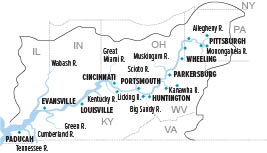 Click to enlarge For more information about source water protection or to find out what you can do to help, visit: myGCWW.org,
email: info@gcww.cincinnati-oh.gov,
call: Greater Cincinnati Water Works at 513.591.7700,
or call: the Groundwater Consortium at 513.785.2464.
A Leader in Water Quality Treatment and Technology
GCWW uses state-of-the-art water treatment processes that create multiple barriers to protect public health. GCWW treatment processes include Coagulation/Flocculation/Sedimentation, Sand Filtration, Granular Activated Carbon (GAC), ultraviolet (UV) light and chlorine to remove and treat for natural and man-made contaminants from our drinking water. It is one of the first in the nation to use a combination of all these treatment methods.
GCWW typically treats about 120 million gallons of water a day, and ensures that all the treatment processes are effective by using more than 600 daily tests.
GCWW also treats the drinking water specifically to minimize the amount of lead that may leach into the drinking water from home plumbing — this treatment process is called corrosion control. There is no lead in the water as it leaves GCWW treatment plants, and this process minimizes the chance that lead can be picked up from home plumbing.
Granular Activated Carbon
GCWW’s Richard Miller Treatment Plant is one of only a few water treatment plants in the nation that incorporates granular activated carbon (GAC) with on-site reactivation into its water treatment process. This state-of-the-art technology uses granular carbon, which contains numerous microscopic cavities. When water is passed through the GAC, impurities adhere to the carbon and are removed from the water. Benefits of GAC include: barrier against chemical spills in the Ohio River; barrier against impurities in raw source water; less chlorine required for disinfection; reduced disinfection by-products; and improved control of taste and odor.
Ultraviolet Disinfection
GCWW is the largest water utility in North America to use UV disinfection following rapid sand filtration and GAC adsorption. UV disinfection, which uses rays of intense light to disinfect water, is one of the most effective methods used to protect against microorganisms such as Cryptosporidium.
The following diagrams illustrate the treatment processes at the Richard Miller and Charles M. Bolton Treatment Plants
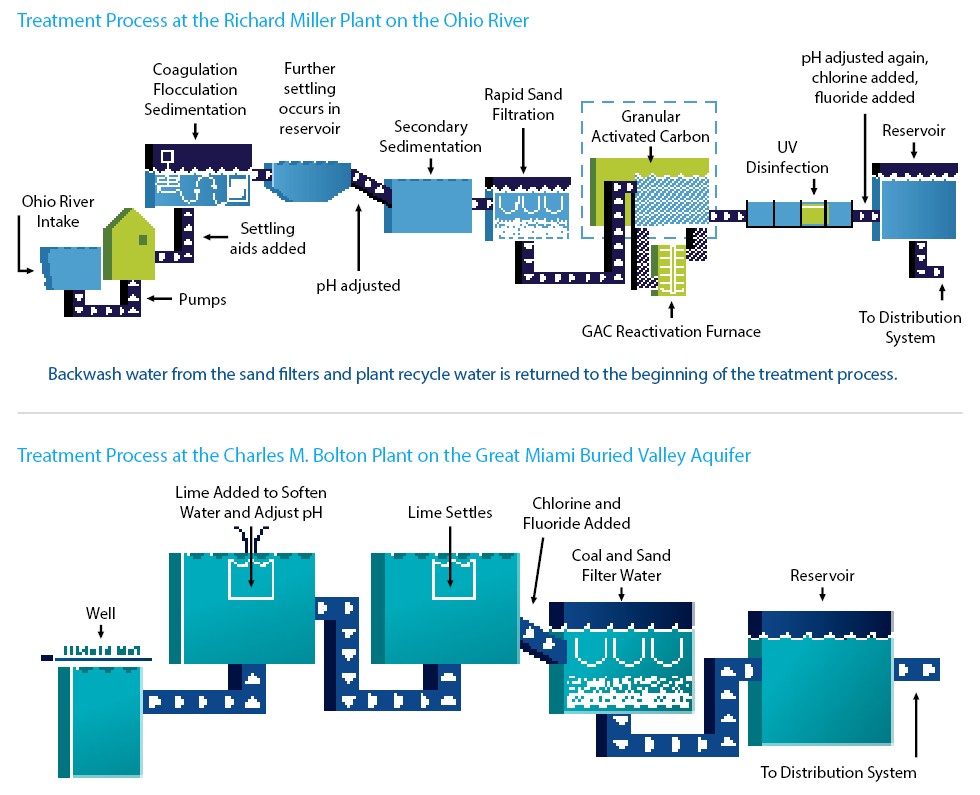 Click to enlarge
GCWW Meets or Exceeds All State and Federal Health Standards
GCWW is proud to say that our water meets or exceeds all health standards established by both the USEPA and the Ohio EPA. To ensure that tap water is safe to drink, the USEPA issues regulations that limit the levels of certain contaminants in water provided by public water systems. Food and Drug Administration (FDA) regulations establish limits on contaminants in bottled water, which shall provide the same level of public health protection. The tables below show the substances detected in GCWW drinking water while performing the most up-to-date monitoring required by the EPA. The Ohio EPA requires GCWW to monitor for certain contaminants less than once per year because their concentrations do not change frequently. Because of this, some of our data, though accurate, is more than one year old. For a complete listing of GCWW test results and additional water quality information, visit WQT.myGCWW.org, or call 513.591.7700.
DATA TABLES
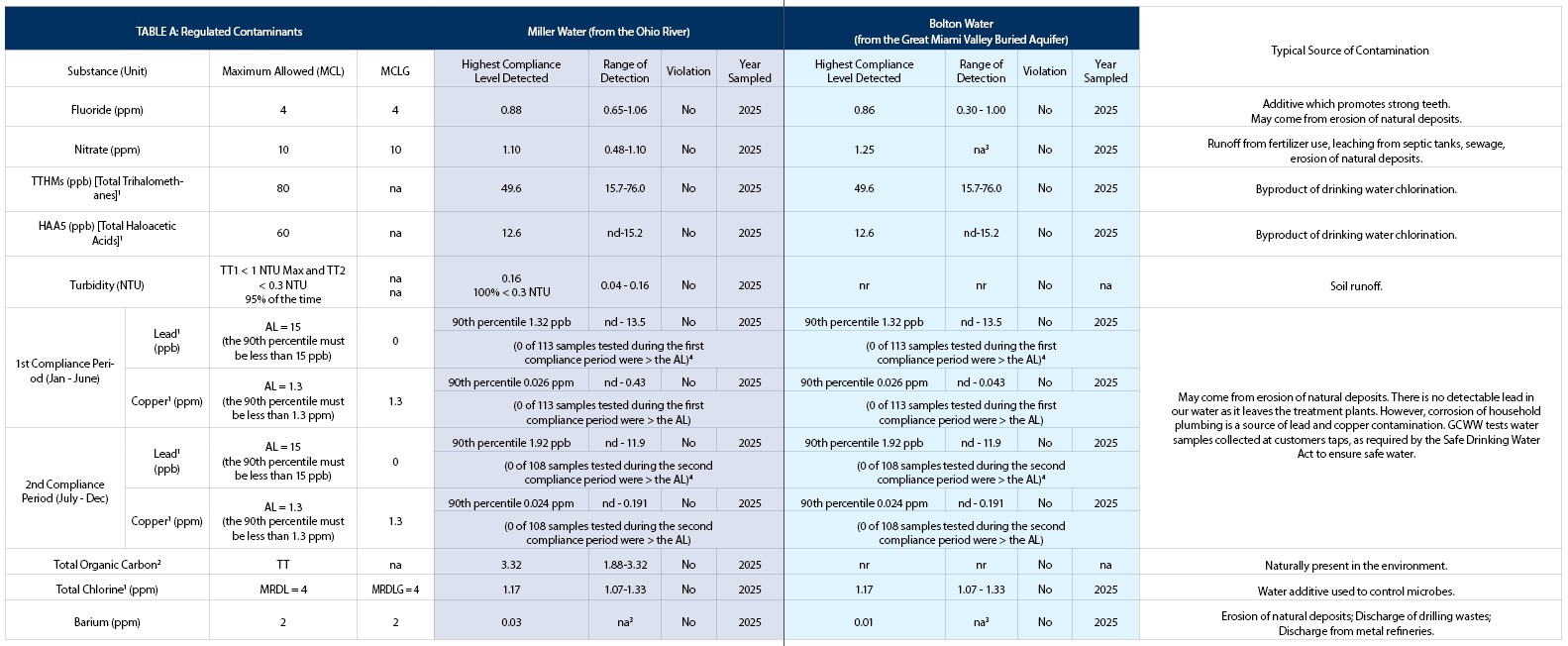
Regulated Contaminants (Table A): Substances subject to a Maximum Contaminant Level (MCL), Action Level (AL), or Treatment Technique (TT). These standards protect drinking water by limiting the amount of certain substances that can adversely affect public health and are known or anticipated to occur in public water systems.
 Click to enlarge
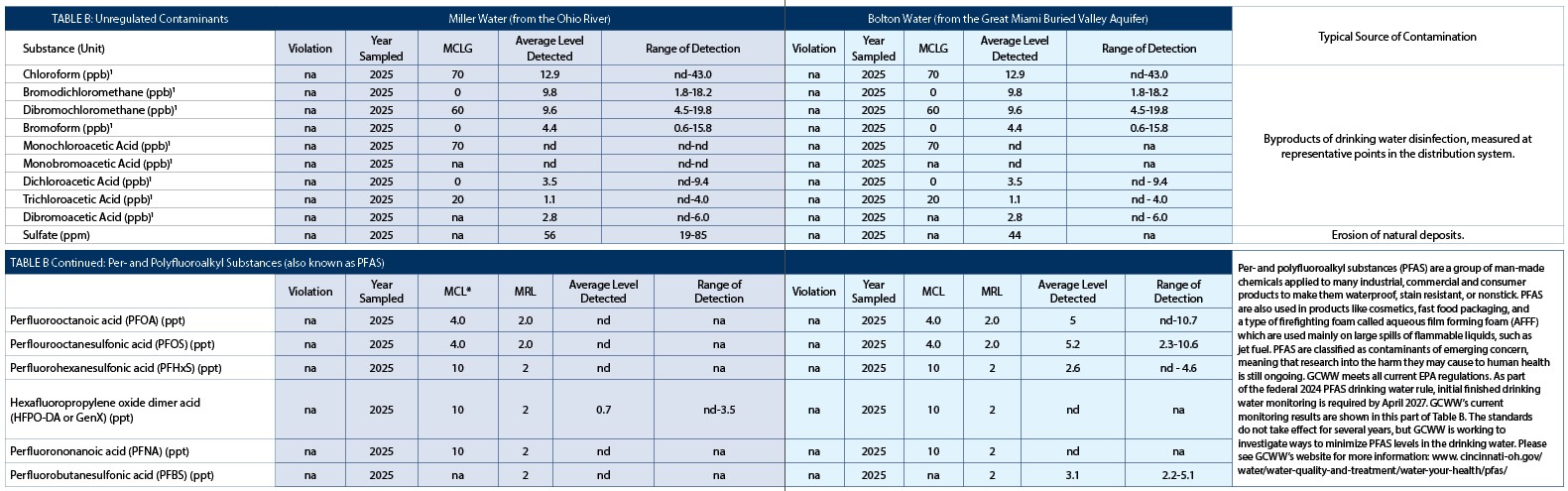
Unregulated Contaminants (Table B): Unregulated contaminants are those for which EPA has not established drinking water standards. The purpose of unregulated contaminant monitoring is to assist the EPA in determining the occurrence of unregulated contaminants in drinking water and whether future regulation is warranted. Additional contaminants were monitored and not detected. If you would like further information on the results of unregulated contaminant monitoring, please call 513.591.7700.
 Click to enlarge
Abbreviations
ppt: parts per trillion or nanograms per liter; a part per trillion corresponds to one second in approximately 32,000 years
ppb: parts per billion or micrograms per liter; a part per billion corresponds to one second in 31.7 years
ppm: parts per million or milligrams per liter; a part per million corresponds to one second in a little over 11.5 days
nr: not regulated
na: not applicable
NTU: Nephelometric Turbidity Unit (used to measure clarity in drinking water)
nd: not detectable at testing limits
TTHMs: Total Trihalomethanes
HAA5: Haloacetic Acids
Definitions:
Minimum Reporting Level or MRL: The contaminant level that can reliably be detected using the specified analytical method.
Maximum Contaminant Level Goal or MCLG: The level of a contaminant in drinking water below which there is no known or expected risk to health. MCLGs allow for a margin of safety.
*Maximum Contaminant Level or MCL: The highest level of a contaminant that is allowed in drinking water. MCLs are set as close to the MCLGs as feasible using the best available treatment technology. MCLs for PFAS compounds will be effective in 2029.
Action Level or AL: The concentration of a contaminant, which, if exceeded, triggers treatment or other requirements that a water system shall follow.
Treatment Technique or TT: A required process intended to reduce the level of a contaminant in drinking water.
Maximum Residual Disinfection Level or MRDL: The highest level of a disinfectant allowed in drinking water. There is convincing evidence that the addition of disinfectant is necessary for the control of microbial contaminants.
Maximum Residual Disinfection Level Goal or MRDLG: The level of drinking water disinfectant below which there is no known or expected risk to health. MRDLGs do not reflect the benefits of using disinfectants to control microbial contaminants.
Turbidity: Utilities that treat surface water are required to report on turbidity as an indication of the effectiveness of the filtration system. Turbidity is a measure of the cloudiness of water. The turbidity limit set by the EPA is 0.3 NTU in 95% of the samples analyzed each month, and shall not exceed 1 NTU at any time. As reported in the table, GCWW’s highest turbidity result for 2025 was 0.16 NTU (Miller Water), and the lowest monthly percentage of samples meeting the turbidity limits was 100%.
The < symbol: A symbol which means less than. A result of < 5 means that the lowest level that could be detected was 5, and the contaminant in that sample was not detected.
Lead Threshold Level: The concentration of lead in an individual tap water sample. The lead threshold level is exceeded at 0.015 milligrams per liter (15 ppb) concentration of lead in an individual tap water sample.
Footnotes:
1. Miller and Bolton were considered as one distribution system for regulatory purposes by the Ohio EPA in 2025. The data listed for each system represent the combined distribution system.
2. The value reported under “Highest Compliance Level Detected” for Total Organic Carbon (TOC) is the lowest ratio between the percentage of TOC actually removed and the percentage of TOC required to be removed. A value of greater than one (1) indicates that the water system is in compliance with TOC removal requirements. A value of less than one (1) indicates a violation of the TOC removal requirements.
3. GCWW collects one sample per year. 4. 0 of 113 samples were found to have lead levels in excess of the lead threshold level of 15 ppb during the first compliance period of 2025 (Jan-June). 0 of 108 samples were found to have lead levels in excess of the lead threshold level of 15 ppb during the second compliance period of 2025 (July-Dec).
FREQUENTLY ASKED QUESTIONS
1. If there are reported contaminants, how can my water be safe?
Drinking water, including bottled water, may reasonably be expected to contain small amounts of contaminants. The presence of contaminants does not necessarily indicate that the water poses a health risk. However, some people may be more vulnerable to contaminants in drinking water than the general population. Immunocompromised persons, such as persons with cancer undergoing chemotherapy, persons who have undergone organ transplants, people with HIV/AIDS or other immune system disorders, some elderly, and infants, can be particularly at risk from infections. These people should seek advice about drinking water from their healthcare providers. More information about contaminants and potential health effects can be obtained by calling the United States Environmental Protection Agency’s (USEPA) Safe Drinking Water Hotline at 800.426.4791.
2. What is Cryptosporidium?
Cryptosporidium (Crypto) is a microscopic organism that, when ingested, can result in diarrhea, fever, and other gastrointestinal symptoms. Crypto is found in surface waters and comes from animal and human waste. GCWW routinely tests for Crypto and did not detect it in our finished water in 2025. GCWW also tested for Crypto in the Ohio River surface water, and it was detected in 1 of 4 samples during 2025. USEPA/CDC guidelines on appropriate measures to reduce the risk of infection from Cryptosporidium and other microbial contaminants are available from the Safe Drinking Water Hotline at 800.426.4791.
3. Why is fluoride added to my water?
Fluoride is added to the water to protect teeth as required by a state law passed in 1969. According to the American Dental Association, persons who drink fluoridated water have a 20% to 40% reduction in the amount of cavities that would have occurred without fluoride. Some home filtration devices remove fluoride. Bottled water may not contain fluoride.
4. How much sodium is in my water?
GCWW has tested for sodium in treated water as it leaves the treatment plants and has found 31 mg (milligrams) per liter in the Richard Miller Water and 32 mg per liter in the Charles M. Bolton Water. There are approximately four cups in a liter.
5. Is there lead in my water?
There is no detectable lead in drinking water as it leaves the treatment plants. If present, elevated levels of lead can cause serious health problems, especially for pregnant women and young children. Lead in drinking water is primarily from materials and components associated with service lines and home plumbing. GCWW is responsible for providing high-quality drinking water, but it cannot control the variety of materials used in plumbing components. When your water has been sitting for several hours, you can minimize the potential for lead exposure by flushing your tap for 30 seconds to 3 minutes before using water for drinking or cooking. If you are concerned about lead in your water, you may wish to have your water tested.
A list of laboratories certified in the State of Ohio may be found at epa.ohio.gov/ddagw or by calling 614.644.2752. Information on lead in drinking water, testing methods, and steps you can take to minimize exposure is available from the Safe Drinking Water Hotline 800.426.4791 or at epa.gov/safewater/lead.
GCWW tests customers’ water for lead at no cost. Lead information, including a lead service line lookup map which identifies where lead lines are located, and a request for test kits, can be found at lead.myGCWW.org or by calling 513.651.LEAD (5323).
6. Sometimes my water is reddish-brown. What should I do?
The reddish-brown color can be caused by rust from corrosion in GCWW’s pipes, the pipes in your home, or from corrosion in your home’s water heater. If you have rusty water, try running cold water for several minutes. If you have questions or your laundry is stained from rusty water, call GCWW at 513.591.7700. We will deliver a laundry aid to remove the rust. Do NOT put stained laundry in the dryer.
7. Why does drinking water sometimes look cloudy?
Cloudy water that clears quickly from the bottom up is caused by tiny air bubbles in the water, similar to gas bubbles in soda. The bubbles rise to the top and disappear. This cloudiness occurs more often in the winter when the drinking water is cold. Air does not affect the safety of water.
8. How hard is GCWW’s water?
Hard water is water that contains more minerals, such as calcium and magnesium. Water from GCWW’s Richard Miller Plant has an average hardness of 126 mg per liter or 7 grains per gallon. Water from the Charles M. Bolton Plant averages 140 mg per liter or 8 grains per gallon. Hardness does not affect the safety of water.
Contact GCWW
Want more information about water quality, customer billing, or to submit comments about this report?We’re here to help! Visit www.myGCWW.org or call Customer Service at 513.591.7700. Office hours are 7:30 am – 4:30 pm, Monday through Friday.
For More Information About...
Lead Awareness
Website: lead.myGCWW.org
Phone: 513.651.LEAD (5323)
USEPA Safe Drinking Water
Website: epa.gov/ground-water-and-drinking-water
Safe Drinking Water Hotline: 800.426.4791
The Food and Drug Administration (FDA)
Website: fda.gov
Phone: 888.463.6332
NSF International
Website: nsf.org
Phone: 800.673.6275
Attend the Following Meetings to Participate in Water Decisions:
City of Cincinnati Council
Website: cincinnati-oh.gov
Phone: 513.352.3246
ORSANCO
Website: orsanco.org
Phone: 513.231.7719
OKI Regional Council of Governments Groundwater Committee
Website: oki.org
Phone: 513.621.6300
Educational Resources
Two online Teacher Resource areas are available for teachers, students, and parents. These sites are full of educational resources, videos, activity ideas, links, and more -- schedule a group tour of the Water Museum or Historic Old River Station online as well!
Tours: https://www.cincinnati-oh.gov/water/about/tours/
Water Quality Website: cincinnati-oh.gov/water/about/teacher-resources
Stormwater Website: cincinnati-oh.gov/stormwater/teacher-resources
The GCWW lead program is being used to meet a portion of the notification requirements in OAC Rule 3745-83-02. This report meets the Ohio and USEPA’s National Primary Drinking Water Regulation for Consumer Confidence Reports. GCWW has a current unconditioned license to operate from the Ohio Environmental Protection Agency.
City of Cincinnati is an Equal Opportunity/Affirmative Action Employer. Notice Under the ADA: The City of Cincinnati will not discriminate against qualified individuals with disabilities in its programs, services, or activities. If you require any special accommodations or communication aids, visit www.cincinnati-oh.gov/manager/ada.
GCWW provides Water Quality Report information for its customers. Updated by April 1 of each year, this publication and informaiton complies with the U.S. EPA's National Primary Drinking Water Regulation for Consumer Confidence Reports.
Content Updated 03/26/2026
*******
Want to go behind-the-scenes and learn more about Greater Cincinnati Water Works history, billing, your rates, treatment processes, meter reading, and more? Register today for the Citizens Water Academy at WaterAcademy.mygcww.org!
On average, GCWW treats about 132 million gallons of water per day and conducts about 600 tests daily throughout the water treatment and distribution process. Monitors and alarm systems are also located throughout the treatment plants and in the distribution system to continuously monitor water quality. The Ohio EPA reviews test results monthly, and every year, GCWW water meets or exceeds all state and federal drinking water health standards.
These tests include:
• Source water -- tested routinely before it enters treatment plants.
• Treated Water -- tested after each step in the treatment process.
• Water from the distribution system -- sampled and analyzed regularly.
GCWW draws its water from the Ohio River and the Great Miami Aquifer near Fairfield and uses state-of-the-art water treatment technology, including:
• Sand filtration
• Granular Activated Carbon adsorption (GAC)
• Powdered Activated Carbon (PAC)
• Ultraviolet disinfection (UV)
• Corrosion Control
More about GCWW State-of-the-art Water Treatment Process